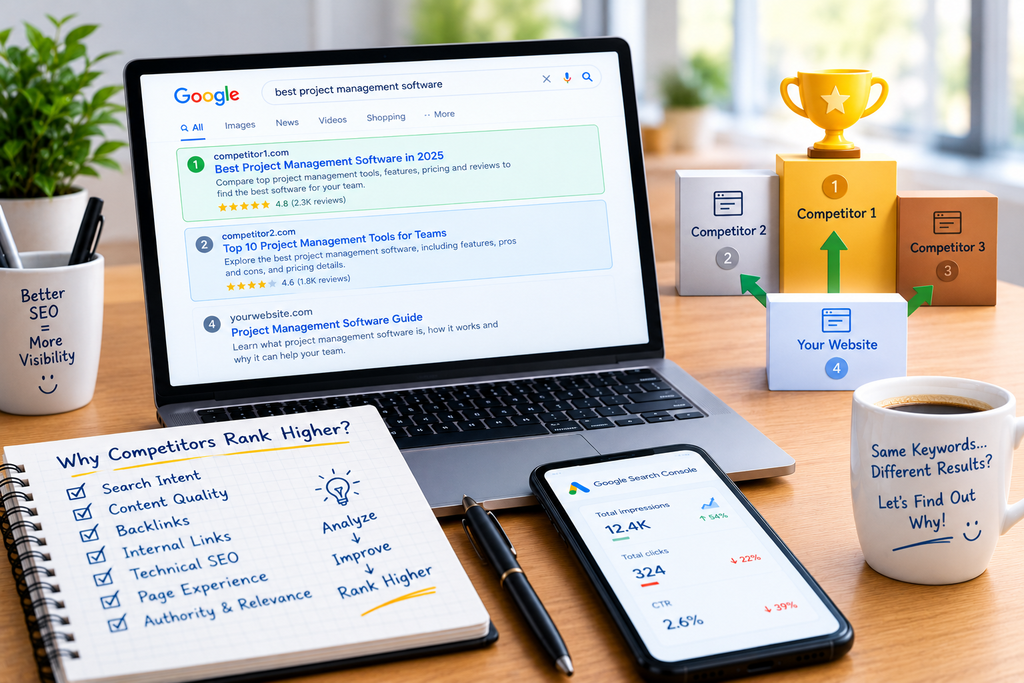
If your competitors are ranking above your website for the same keywords, it does not necessarily mean they are doing one thing that you are missing. Google evaluates pages using multiple systems and signals, and the most relevant comparison is usually your page versus the pages that currently satisfy the same search intent.
A competitor may have more useful content, stronger relevance for the query, better internal linking, more relevant links from other websites, stronger topical coverage, better page experience, or a combination of several factors.
Google’s own documentation emphasizes that Search is designed to show relevant and helpful results, while its ranking systems use many signals rather than one universal ranking factor. Google also states that there is no single “page experience signal” that determines ranking.
That means the useful question is not simply:
“Why does Google like my competitor more?”
Instead, ask:
“What does the competing page demonstrate that my page does not demonstrate as clearly?”
That shift makes competitor analysis much more practical.
1. Your Page May Not Match the Search Intent as Closely
Search intent is one of the first things to investigate when another website consistently outranks yours.
A keyword can look like a single topic while representing several different needs.
For example, someone searching for:
“best email marketing software”
is likely looking for options to compare.
Someone searching for:
“how does email marketing work”
is looking for an explanation.
Someone searching for:
“Mailchimp pricing”
has a much more specific commercial or navigational need.
If your page targets the same words but answers a different question, adding more keywords may not solve the problem.
How to check intent
Search the target keyword and examine the pages ranking near the top.
Look at:
- What type of page is ranking?
- Is it a guide, product page, category page, comparison, tutorial, or landing page?
- What questions does it answer?
- What information appears near the beginning?
- What format does Google appear to be rewarding?
- What does the searcher probably want to accomplish?
Then compare those observations with your own page.
If the SERP is dominated by detailed guides while your page is primarily promotional, or competitors are comparison pages while yours is a generic article, the problem may be intent mismatch rather than insufficient keyword density.
2. Your Competitors May Cover the Topic More Completely
Longer content is not automatically better content.
A 3,000-word article can still be less useful than a focused 1,500-word page if it spends hundreds of words repeating obvious information.
What matters is whether the page covers the important parts of the topic that users actually need.
For example, a page about choosing accounting software may need to address:
- Features
- Pricing considerations
- Business size
- Integrations
- Reporting
- Security
- Ease of use
- Limitations
- Migration considerations
If a competitor answers the important decision-making questions while your page only defines the software, the competitor may provide a more complete answer.
Google’s Search guidance emphasizes creating helpful, reliable, people-first content rather than producing content primarily to manipulate rankings.
The practical lesson is simple:
Do not ask how many words your competitor has. Ask what useful questions their page answers that yours does not.
3. Your Content May Be Relevant but Less Specific
A common SEO mistake is writing around a broad subject instead of solving the exact problem behind the query.
Consider the keyword:
“why is my WordPress website slow?”
A weak page might discuss website speed generally.
A more useful page would explain specific causes such as:
- Large images
- Excessive plugins
- Poor hosting performance
- Unoptimized scripts
- Caching configuration
- Database-related issues
- Third-party resources
The second page gives the searcher a practical diagnostic path.
This is where competitor analysis should go deeper than copying headings.
Identify the questions, decisions, problems, and actions covered by competing pages. Then determine which of those are missing or poorly explained on your page.
4. Your Website May Have Weaker Internal Linking
Internal links help users and search engines navigate between related pages.
Suppose you have five strong articles about technical SEO, but none of them link to your main technical SEO service page.
Another website may have a much clearer network connecting:
SEO guide → technical SEO topic → related problem → service page
Your pages may individually be useful, but the overall site structure can make relationships between topics less obvious.
Review your internal links for important pages.
Ask:
- Which pages link to this target page?
- Are those pages genuinely related?
- Does the anchor text describe the destination?
- Are important pages several clicks away?
- Do supporting articles connect naturally to the main topic?
- Are there orphaned pages with few or no internal links?
Internal linking should help visitors discover relevant information rather than exist purely as an SEO exercise.
5. Your Competitors May Have More Relevant External Links
Links from other websites can be part of Google’s systems for understanding and ranking web pages, but the useful question is not simply who has the largest backlink count.
A competitor could have fewer links overall but more links from websites that are relevant to its industry or topic.
For example, a cybersecurity company receiving relevant references from established technology publications, security organizations, universities, or industry resources is different from a site accumulating large numbers of unrelated directory links.
Do not treat backlink volume as a simple ranking score.
Instead, investigate:
- Which pages attract links?
- Where do those links come from?
- Are the referring websites relevant?
- Why did they link?
- Does your website have original resources worth referencing?
- Could you create genuinely useful research, data, tools, guides, or explanations?
The goal should be earning relevant references because your content is useful—not manufacturing links simply because a competitor has more.
6. Your Site May Have Less Topical Coverage
One page rarely establishes expertise around an entire subject.
Suppose your primary service is web development.
You might have one page titled:
Web Development Services
A competitor may have that service page plus detailed resources covering:
- Front-end development
- Back-end development
- WordPress development
- E-commerce development
- Website performance
- Web accessibility
- Website security
- CMS selection
- Development costs
- Maintenance
That broader coverage can help users understand the subject and create more opportunities for relevant internal linking.
This does not mean publishing hundreds of shallow pages simply to cover keywords.
Build supporting content where it genuinely helps your audience understand the main topic.
7. Your Competitor May Have a Stronger Page Experience
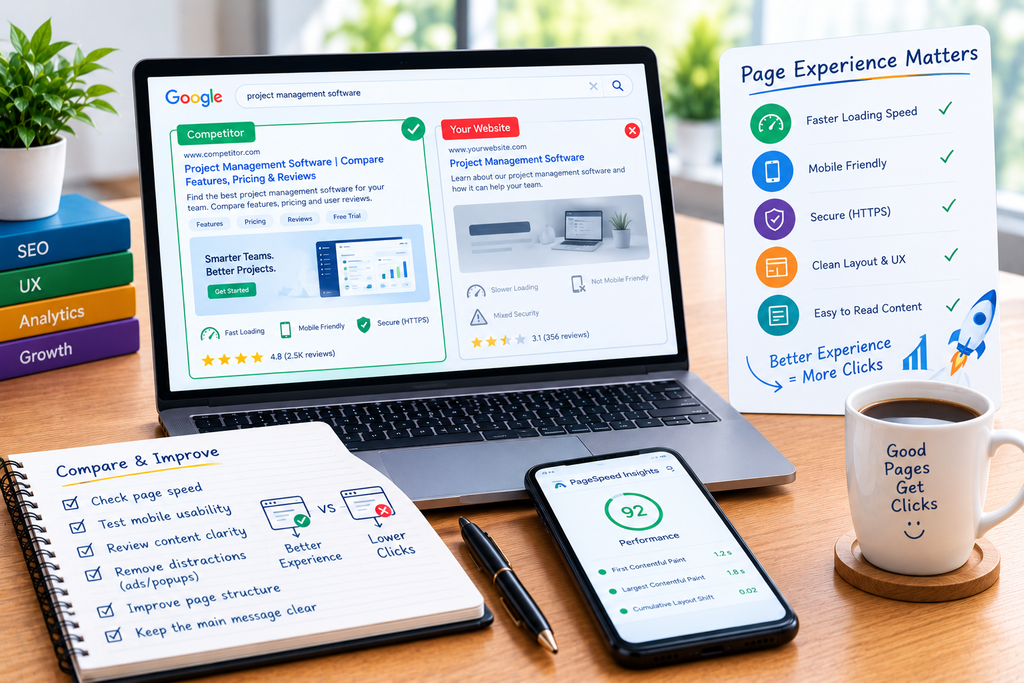
Page experience is another area worth checking, but it should not be treated as a magic ranking switch.
Google says its core ranking systems consider multiple aspects of page experience and recommends paying attention to factors such as Core Web Vitals, mobile usability, secure delivery, intrusive interstitials, excessive ads, and whether the main content is easy to distinguish. Google also explicitly says good Core Web Vitals alone do not guarantee top rankings.
Check your competing pages alongside your own for obvious usability differences.
For example:
- Does your page take noticeably longer to load?
- Is the mobile layout difficult to use?
- Are advertisements interrupting the content?
- Is the main answer buried below unnecessary elements?
- Does the competitor provide a cleaner reading experience?
- Are important interactive elements difficult to use?
Fixing these issues can improve the user’s experience even when they are not the sole reason for a ranking difference.
8. Your Technical SEO May Be Limiting the Page
Before spending weeks rewriting content, make sure Google can properly access, understand, and index the page.
Check:
- Indexing status
- Canonical URL
- Robots directives
- Robots.txt
- HTTP status
- Mobile rendering
- Duplicate URLs
- Redirects
- Sitemap inclusion
- Internal links
- Structured data where appropriate
If Google is unable to index the intended page or is treating another URL as canonical, content improvements will not solve the underlying problem.
For a detailed troubleshooting process, your related article Why Are My Website Pages Not Being Indexed by Google, and How Can I Fix It? is the natural internal link here because indexing problems need to be ruled out before comparing ranking strength.
9. Your Competitor May Have a Stronger Search Result, Not Just a Better Page
Ranking position and click performance are connected but not identical.
A competitor may present a clearer title, more useful snippet, stronger brand recognition, or a result format that better matches what the searcher wants.
Google Search Console lets you analyze impressions, clicks, CTR, queries, pages, countries, devices, and search appearance. Google specifically recommends using Search Console to identify queries where your site receives impressions but relatively few clicks, then searching those queries to see what may be attracting users to other results.
This makes Search Console an important part of competitor analysis.
If your page receives many impressions but few clicks, do not automatically assume that your entire page needs to be rewritten.
First determine:
Is the problem ranking, relevance, or search-result presentation?
10. Your Competitor May Simply Be More Relevant for That Specific Query
Sometimes the explanation is straightforward: the competing page is a better match for that particular search.
That does not mean the competitor is better at SEO across the entire website.
A site can outrank another domain for one keyword and lose for another.
Google Search Console’s Performance report allows you to analyze performance by query and page, while its comparison and filtering tools allow more detailed segmentation by dimensions such as country, device, page, and date.
Therefore, avoid making broad conclusions from one keyword.
Look for patterns.
If the same competitor repeatedly outranks you for closely related searches, investigate what those pages have in common.
How to Perform a Competitor SEO Gap Analysis
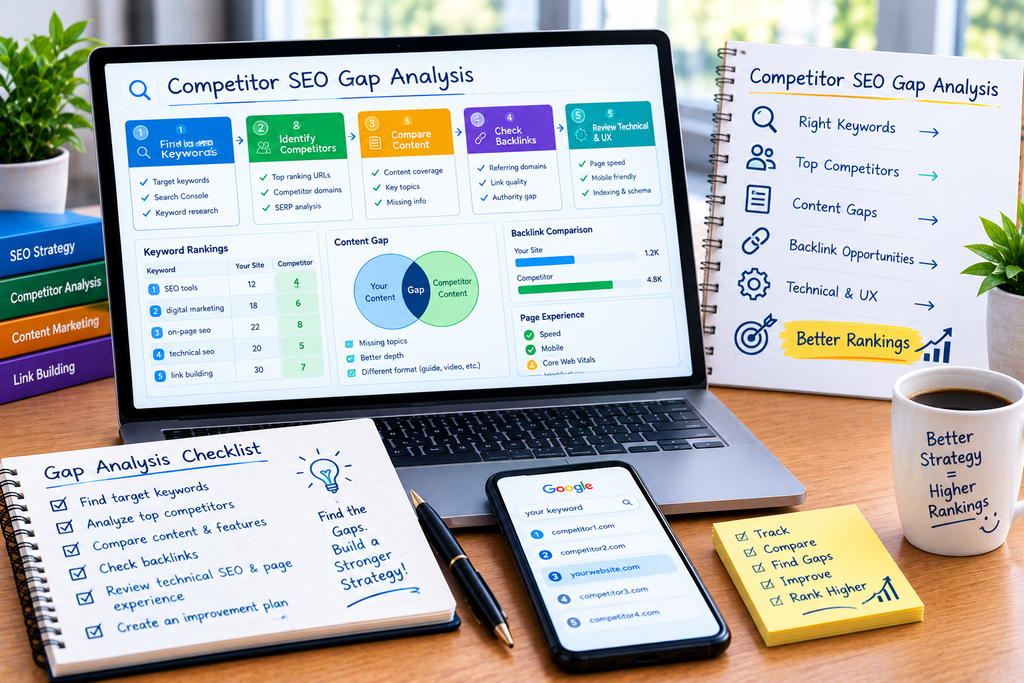
Step 1: Choose important keywords
Start with keywords where your website already has visibility or where the query is strongly connected to your business.
Search Console’s Performance report can show which queries are already producing impressions and clicks.
Step 2: Identify the competing URLs
Search each important keyword and record the pages ranking above yours.
Do not only record domain names.
The specific competing URL matters because Google ranks pages for queries, not simply websites as one undifferentiated entity.
Step 3: Compare search intent
Document the purpose of each ranking page.
Is it:
- Informational?
- Commercial?
- Transactional?
- Navigational?
- Local?
- Comparison-focused?
Then compare that with your page.
Step 4: Compare content coverage
Create a simple gap list:
Competitor covers → My page covers → Missing information
Look for useful differences rather than copying the competitor’s wording.
Step 5: Review internal and external links
Identify how the competitor’s page is connected to its website and whether reputable external websites reference it.
Then inspect your own site’s supporting pages and relevant references.
Step 6: Check technical and page experience issues
Make sure the page is indexable, mobile-friendly, usable, and technically sound.
Step 7: Improve the page based on evidence
Update the page where there is a genuine gap:
- Clarify the answer
- Improve structure
- Add missing useful information
- Remove unnecessary repetition
- Improve internal links
- Strengthen relevant supporting content
- Fix technical problems
- Improve usability
- Make the title accurately represent the page
Do not rewrite a page simply because a competitor uses more words.
What You Should Not Do to Outrank Competitors
Competitor analysis can become counterproductive when it turns into copying.
Avoid:
- Copying competitor paragraphs
- Reproducing their heading structure word-for-word
- Adding keywords unnaturally
- Buying large quantities of unrelated backlinks
- Creating dozens of thin pages
- Changing URLs without a clear reason
- Obsessing over one ranking position
- Assuming every ranking difference has one identifiable Google factor
Google’s documentation emphasizes that Search uses many systems and that page experience, content usefulness, and relevance need to be considered together rather than reduced to one isolated ranking trick.
How Long Does It Take to See Ranking Improvements?
There is no reliable universal timeframe for a ranking improvement.
After changing a page, Google needs to recrawl and process the updated content, and your results can also be affected by changes to competing pages, search behavior, and Google’s systems.
Google recommends using Search Console comparisons to evaluate changes over time and notes that it can be difficult to attribute a performance change to one specific edit because other factors can change simultaneously.
For that reason, document what you changed and compare the relevant query and page performance before and after the update.
Final Takeaway
If competitors are ranking higher than your website for the same keywords, do not start by adding more keywords or copying their content.
First determine why the competing page is a stronger match for the search.
Compare search intent, content coverage, specificity, internal linking, relevant external references, technical accessibility, page experience, and search-result presentation. Then use Google Search Console to identify the queries and pages where the difference is actually occurring.
The objective is not to make your page look more like the competitor.
It is to make your page more useful, more relevant, easier to understand, and better connected to the needs behind the search query.
A strong competitor analysis therefore produces a concrete improvement plan:
keyword → competing page → search intent → content gap → technical gap → authority/link gap → page improvement → performance measurement.
That process gives you something much more useful than a generic list of ranking factors: a specific explanation of what your page needs to improve for the searches that matter to your business.
FAQs
1. Why are my competitors ranking higher than my website for the same keywords?
There is usually no single explanation. Compare the competing page with yours for search intent, content completeness, relevance, internal linking, external references, technical accessibility, page experience, and search-result presentation. The most useful comparison is between the two specific pages ranking for the query, rather than between entire domains.
2. How can I find out why a competitor outranks my page?
Start by selecting keywords where the competitor consistently appears above your page. Search each query and compare the actual ranking pages. Analyze what each page answers, its content format, topical coverage, internal links, usability, and relevant external references. Then use Google Search Console to examine your own impressions, clicks, CTR, queries, pages, and average position.
3. Does having more backlinks mean my competitor will always rank higher?
No. Backlinks are only one part of a much broader search-ranking system. The relevance and context of links matter more than treating the total number of backlinks as a simple ranking score. A competitor can also outperform your page because it better satisfies search intent or provides more useful content.
4. Should I make my article longer than my competitor’s article?
Not simply for the sake of word count. A longer article can still be less useful if it contains repetition or information unrelated to the search. Instead, identify important questions or problems that competing pages answer and determine whether your page addresses them clearly and accurately.
5. Can Core Web Vitals help my website rank higher than competitors?
Core Web Vitals are part of Google’s page-experience considerations, but Google explicitly says that good Core Web Vitals do not guarantee top search rankings. Page experience should therefore be treated as one part of a broader SEO strategy rather than a standalone method for overtaking competitors.
6. How long should I wait after updating a page before judging its SEO performance?
There is no fixed number of days that guarantees a ranking change. Google needs to recrawl and process updates, while competitors and search behavior can change at the same time. Use Search Console to compare performance over appropriate time periods and record the changes you made so you can interpret the results more reliably.
Let’s Talk About Your Business
Not sure which approach is right for your business? Get a free consultation with our team.