
Getting thousands of Reel views but very few website visits or sales is one of the most confusing problems for a social media marketer. Your videos may be reaching non-followers, people may be watching them to the end, and some may even share them, yet your website traffic remains low and your products do not sell.
The problem is that views are an attention metric, not a purchase metric.
Instagram and Facebook use recommendation systems to personalize the content people see based on signals from their activity and interactions. Meta explains that its AI systems rank content across surfaces such as Feed, Reels and Stories according to predictions about what users are likely to find relevant or valuable. Meta: How AI Influences What You See on Facebook and Instagram This allows a Reel to reach people who have never heard of your business.
But discovery is only the first stage. A successful business Reel needs to move the right viewer from watching → becoming interested → visiting your profile → clicking through → trusting the offer → purchasing.
If that journey is breaking somewhere, simply getting more views will not necessarily solve the problem.
Why Reel Views Do Not Automatically Become Website Traffic
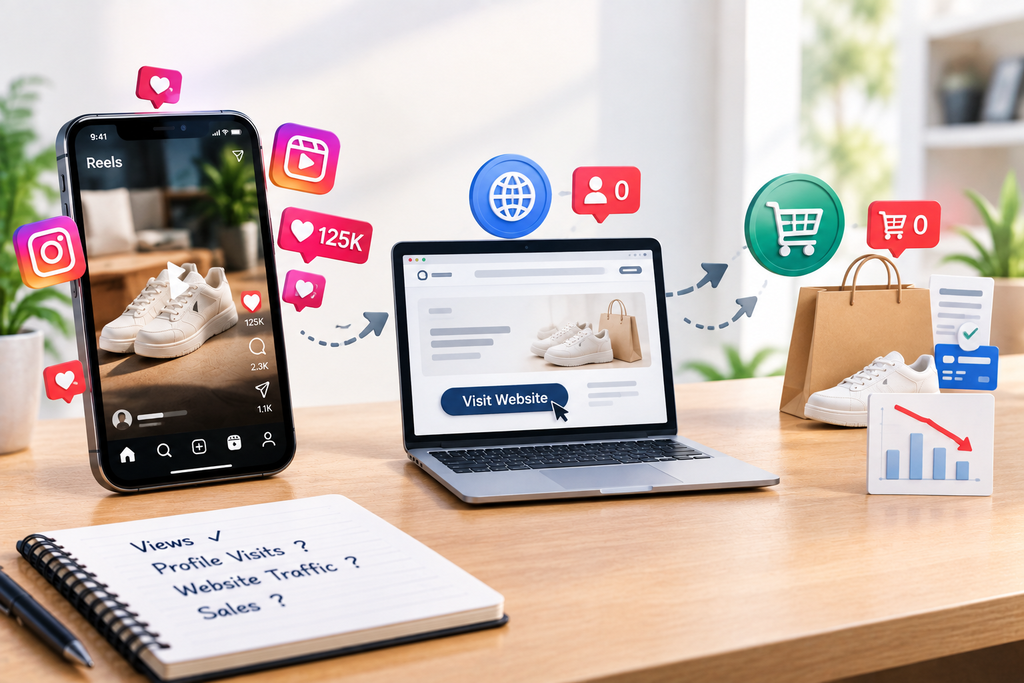
A person can enjoy a Reel without having any intention of visiting the business behind it.
For example, imagine an online clothing store posts a short video showing five outfit combinations. The Reel may attract thousands of viewers because the video is visually appealing and useful. But a viewer may save the idea, continue scrolling, and never visit the store.
The content solved the viewer’s immediate curiosity without creating a strong reason to take another action.
This is why you should separate content consumption from commercial intent.
A Reel can be successful at:
- Generating awareness
- Introducing a problem
- Demonstrating a product
- Entertaining viewers
- Building familiarity
But another piece of content may be better at:
- Driving profile visits
- Generating website clicks
- Answering purchase objections
- Demonstrating product value
- Creating leads
- Generating sales
Your strategy needs both.
1. Your Reel Attracts Viewers Who Are Not Your Customers
One of the most important questions is not “Why aren’t people buying?”
It is:
“Are the people watching actually potential customers?”
Instagram recommendations are designed to help users discover content based on their interests. Meta has also described changes intended to give smaller creators more opportunities to reach new audiences, with eligible content being shown to an initial audience and then potentially distributed more broadly based on how that audience responds. Meta: Helping Creators Find New Audiences
That creates a major opportunity for businesses—but it also creates a potential problem.
A Reel can become popular among people who enjoy the topic without having any commercial interest in your product.
For example, a company selling premium office furniture might post a funny “work from home” Reel. It could attract students, employees, freelancers and general entertainment viewers. The video may perform well, but many of those viewers have no reason to purchase expensive office furniture.
Before changing your CTA, check your audience.
Ask:
- Are viewers in the market for my product?
- Does the Reel address a customer problem?
- Does the content clearly relate to what I sell?
- Are my high-view posts attracting the same people I want to sell to?
If the answer is no, you may have a targeting and content relevance problem, not a traffic problem.
2. Your Reel Does Not Give People a Reason to Click
Many businesses make the mistake of ending every Reel with a generic instruction such as:
“Visit our website.”
That is not always enough.
The viewer needs a reason to leave Instagram.
Compare:
Weak CTA:
“Visit our website to shop.”
Stronger CTA:
“See all 12 available colors and sizes on our website.”
The second CTA tells the viewer what they will get by clicking.
Other useful reasons might include:
- See the complete product range
- Compare available options
- Check current pricing
- View customer reviews
- Get a personalized quote
- See sizes or specifications
- Download a guide
- Book a consultation
- See products featured in the video
The click should feel like the natural next step, not an interruption.
3. Your Product Appears in the Reel but Its Value Is Not Clear
Showing a product is not the same as selling its value.
A product video might show a water bottle rotating against a nice background. It looks professional, but the viewer may still wonder:
- Why is this bottle better?
- Who is it designed for?
- Can I customize it?
- How much does it cost?
- How long does delivery take?
- What makes it different from alternatives?
- Is it suitable for my specific use?
The Reel should answer at least one meaningful purchase question.
For example, instead of simply showing a customized bottle, demonstrate how a school can order bottles with student names, how the design looks at different sizes, or how the finished product appears in real use.
The objective is to turn visual attention into product understanding.
4. Your CTA Comes Too Late or Is Too Weak
People consume short-form video quickly.
If the only mention of your product or website appears in the final seconds, many viewers may never reach it.
That does not mean every Reel needs an aggressive sales pitch.
Instead, make the commercial context clear early enough that viewers understand what they are watching.
For example:
“Looking for personalized bottles for your school team? Here are three options that work well for group orders.”
Now the viewer immediately understands the problem, audience and product context.
The rest of the video can provide useful information and finish with a specific next action.
5. Your Instagram Profile Is Losing the Click
Even when a Reel successfully creates curiosity, the profile can lose the customer.
Someone may watch your Reel, become interested, tap your profile and then encounter:
- An unclear bio
- No obvious website link
- Outdated information
- Unrelated posts
- No product demonstrations
- No customer reviews
- No explanation of what the business offers
At that point, the person has to work too hard to understand what to do next.
Your profile should function like a mini landing page.
A visitor should quickly understand:
Who you serve → What you sell → Why it matters → What to do next
This is especially important when your Reels reach people who have never encountered your business before.
If you are also struggling with [INTERNAL LINK: Instagram followers not increasing], examine the profile experience alongside your content. The same problem that prevents someone from following can also prevent them from clicking through to your website.
6. Your Website Does Not Match the Reel
This is a major but often overlooked problem.
Imagine your Reel promotes a specific product, but clicking through takes the viewer to a generic homepage with no obvious reference to the product.
The viewer now has to search.
That creates friction.
A better journey is:
Reel → Relevant product/category page → Product details → Checkout
If your Reel promotes a particular product, send people to that product when possible rather than making them search the entire website.
The landing page should also match the promise made in the Reel.
If the Reel says:
“See our new personalized team bottles.”
the destination should make those bottles immediately visible.
Do not force users to reconstruct the journey themselves.
7. People Are Interested but Not Ready to Buy
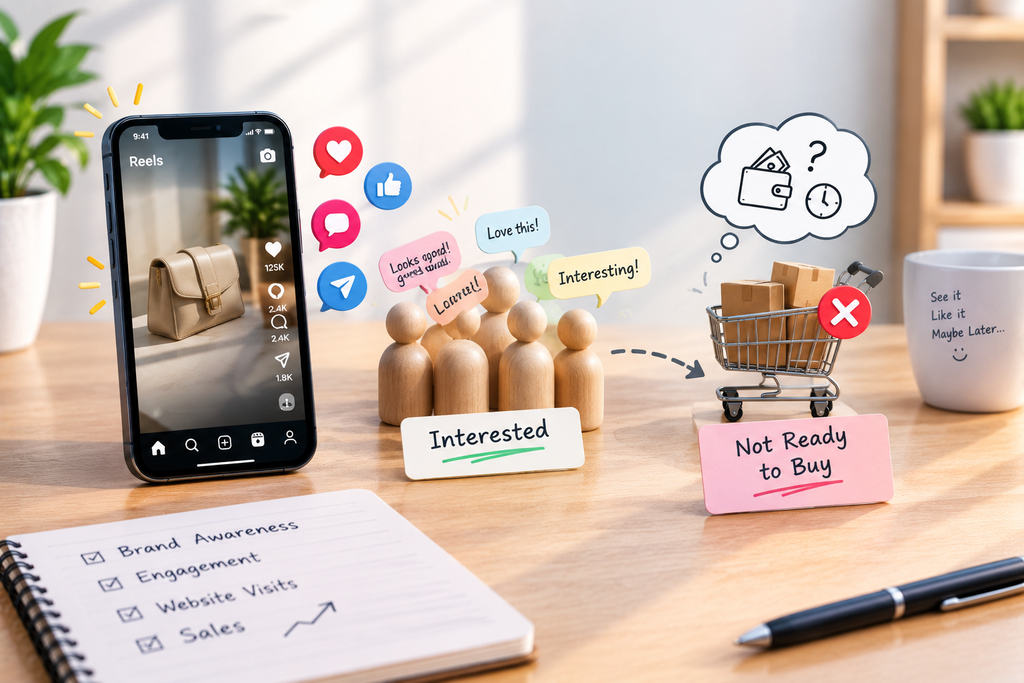
Not every Reel viewer is ready to purchase immediately.
Some are discovering your product for the first time. Others are comparing alternatives. Some may be researching prices or saving products for later.
Baymard Institute’s ongoing ecommerce research is useful here. Its current research reports that 42% of surveyed U.S. online shoppers had abandoned a cart because they were “just browsing” or not ready to buy.
This means a Reel viewer who does not purchase immediately is not necessarily a failed lead.
Your content should support different stages of the buying journey.
Awareness content
Introduce the problem or product.
Consideration content
Explain differences, features, benefits, use cases and objections.
Decision content
Show reviews, demonstrations, pricing, guarantees, shipping information and clear purchasing instructions.
This is much more effective than expecting every Reel to generate an immediate transaction.
8. Your Website Has Too Much Buying Friction
Suppose your Reel successfully sends 500 visitors to your product page but only a handful purchase.
At that point, the problem may no longer be social media.
Check the website.
Look at:
- Page loading performance
- Mobile usability
- Product information
- Product photography
- Pricing clarity
- Shipping costs
- Delivery estimates
- Return policy
- Payment options
- Checkout complexity
- Trust signals
Baymard’s extensive checkout research currently puts average cart abandonment at about 70%, while its research identifies multiple preventable friction points, including unexpected costs, complicated checkout flows, forced account creation and trust concerns.
For example, Baymard’s current research reports that 39% of surveyed users abandoned checkout because extra costs were too high, while 19% abandoned because they did not trust the site with their credit-card information.
Your social media campaign cannot fix a checkout problem that occurs after the click.
9. Your Reel Gets Views Because It Is Entertaining, Not Because It Creates Buying Intent
Entertainment is valuable, but it can create a misleading performance picture.
Suppose a cosmetics company publishes a funny Reel unrelated to its products and gets 500,000 views.
That sounds impressive.
But if the Reel produces only a few profile visits and no product interest, it may be less commercially valuable than a product tutorial with 10,000 views that generates 100 website visits and several orders.
This is why businesses should avoid judging Reels exclusively by views.
Compare:
Reel A
- 100,000 views
- 100 profile visits
- 2 website clicks
- 0 sales
Reel B
- 15,000 views
- 700 profile visits
- 180 website clicks
- 12 sales
Reel B is far more useful for an ecommerce business, even though its view count is much smaller.
How to Turn Reel Views Into Website Visits and Sales
Start by reviewing your best-performing Reels and classify them into three groups.
Group 1: High views + high commercial relevance
These are your strongest opportunities.
Create additional versions around the same customer problem.
Group 2: High views + low commercial relevance
These may be good awareness content, but do not expect them to produce many sales.
Use them selectively.
Group 3: Lower views + strong commercial intent
Do not immediately discard these.
If they attract the right audience and generate website visits, inquiries or purchases, they may be commercially stronger than viral entertainment.
Step 1: Make the customer problem obvious
Start the Reel with a specific problem.
Instead of:
“Here’s our new product.”
Try:
“Struggling to find personalized bottles for a large school team?”
The second opening identifies a person and a problem.
Step 2: Demonstrate the solution
Show the product solving the problem.
Use real demonstrations wherever possible.
Step 3: Explain the next step
Tell viewers exactly what they can do next.
Examples:
“See all available designs on our website.”
“Check the full size guide through the link in our bio.”
“View bulk-order options on our product page.”
Step 4: Match the landing page
Send traffic to the most relevant page rather than a generic destination.
Step 5: Track the complete funnel
Measure:
Views → Profile visits → Website clicks → Product views → Add to cart → Checkout → Purchase
This tells you where the problem is occurring.
If views are high but profile visits are low, improve the content and CTA.
If profile visits are high but website clicks are low, improve the profile.
If website traffic is high but purchases are low, investigate the landing page, offer and checkout.
Use Original Content and Test Different Reel Concepts
Do not assume that every Reel needs to follow the same formula.
Meta has been actively changing how recommendations work. In 2024, Instagram announced changes designed to give smaller creators more opportunities to reach new audiences and prioritize original content in recommendations. Meta: Helping Creators Find New Audiences Meta later introduced Trial Reels, allowing eligible creators to test content with non-followers before deciding whether to share it more broadly. Meta: Trial Reels
That makes testing particularly useful.
Try different versions of:
- Educational Reels
- Product demonstrations
- Customer FAQs
- Comparison videos
- Problem/solution videos
- Testimonials
- Behind-the-scenes content
- Objection-handling content
Then compare not only views, but also profile visits, website clicks, leads and sales.
What to Do If Your Reels Are Getting Views but Sales Are Still Zero
Do not immediately create more content.
First identify the exact break in the funnel.
If people watch but do not visit your profile, the content may lack a compelling next step.
If people visit your profile but do not click, your bio, offer or CTA may be unclear.
If they click but do not purchase, investigate the website and product page.
If they add products to their cart but leave, examine checkout friction, shipping costs, payment options and trust concerns.
This diagnostic approach is much more useful than simply trying to “go viral” again.
If you are experiencing sudden drop in social media engagement, treat that as a separate issue. A Reel can have excellent conversion potential even when overall engagement on the account is temporarily lower.
The Bottom Line
Getting Reel views is valuable, but views are only the beginning of the customer journey.
If people are watching your videos without visiting your website or buying, the solution is usually not to chase even larger view counts. Instead, determine whether you are reaching the right audience, giving viewers a compelling reason to click, communicating your product’s value, providing a strong profile experience and sending visitors to a relevant landing page.
Then examine what happens after the click.
A successful social commerce funnel is not:
Views → Sales
It is closer to:
Relevant views → Interest → Profile visit → Website visit → Product consideration → Trust → Purchase
Once you measure each stage separately, it becomes much easier to identify what needs improvement.
And if your wider business needs a more complete [social media strategy that generates customers, the same principle applies: build your content around customer problems and measurable business outcomes rather than treating reach and views as the final goal.
FAQs
1. Why are my Reels getting views but no website clicks?
High views do not necessarily create click intent. Your Reel may be entertaining without giving viewers a reason to leave Instagram, or the CTA may be too generic. Make the next step specific—for example, tell viewers they can see the complete product range, compare sizes, check pricing or view customer reviews on your website.
2. Why do people watch my Reels but not buy my products?
The viewers may not be your ideal customers, or they may not yet be ready to purchase. Your Reel may also fail to explain the product’s value, price, use case or differentiating features. Check the complete funnel from Reel views to profile visits, website clicks, product views, carts and purchases to identify where potential customers are leaving.
3. Should I focus on Reel views or sales?
For a business, neither should be considered in isolation. Views help measure attention and reach, but sales measure the commercial outcome. A Reel with fewer views that generates qualified website traffic and purchases can be much more valuable than a viral Reel that produces no business results.
4. How can I make my Reels drive more website traffic?
Give viewers a specific reason to click and make the destination relevant to the Reel. If you are showing a particular product, send viewers to that product or a closely related category rather than a generic homepage. Your CTA should explain what the visitor will find after clicking.
5. What should I check if Instagram sends traffic but my website gets no sales?
Review the product page and checkout experience. Check whether pricing, shipping costs, delivery information, returns, payment methods, product details and trust signals are clear. Also test the website on mobile because Reel traffic is predominantly consumed in a mobile-first environment. If visitors add products to carts but abandon checkout, examine checkout friction separately.
6. How long does it take for Reels to generate customers?
There is no fixed timeframe. Some Reels can generate immediate purchases when they reach people with strong buying intent, while other content contributes to awareness and consideration before someone eventually purchases. Instead of expecting every Reel to produce an immediate sale, build a mix of discovery, educational, product-focused and conversion-oriented content and measure the complete customer journey.
Let’s Talk About Your Business
Not sure which approach is right for your business? Get a free consultation with our team.



One Response