
A sudden drop in social media engagement can be frustrating, especially when your content was performing normally just weeks or days earlier. Likes may fall, comments can disappear, fewer people may share your posts, and your reach may suddenly become much lower. The first reaction is often to blame “the algorithm,” but that does not explain every engagement decline.
A drop can come from several different causes: changes in audience behavior, weaker content relevance, inconsistent posting, audience fatigue, changes in content format, reduced distribution, or a mismatch between what you are publishing and what your followers currently want. On platforms such as Facebook and Instagram, recommendation and ranking systems continually personalize what users see based on signals from their activity and interactions. Meta explains that interactions with content influence the recommendations people receive across its platforms. Meta — How AI Influences What You See on Facebook and Instagram
The key is to identify what actually changed before changing your entire social media strategy.
What Does a Sudden Drop in Social Media Engagement Mean?
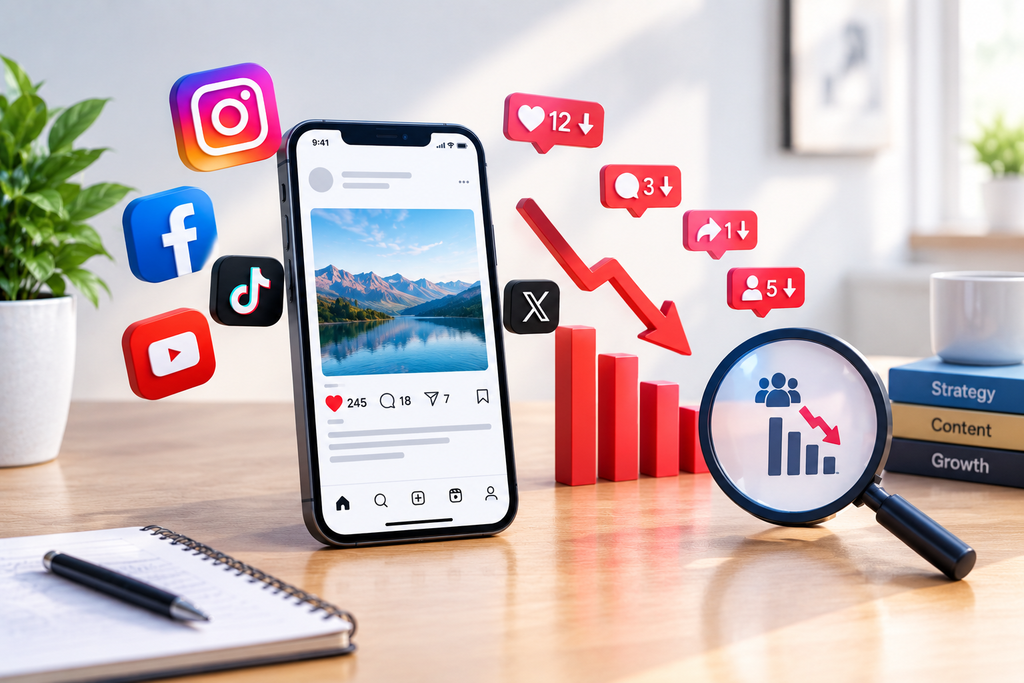
Social media engagement includes actions such as likes, comments, shares, saves, replies, clicks and other interactions with your content. A sudden decline means your recent content is receiving fewer of these actions compared with your normal performance.
However, one poorly performing post does not necessarily mean your account has a problem.
You should look for a pattern across multiple posts.
For example, if your Instagram posts normally receive 500–700 engagements and your last post gets 300, that alone is not enough evidence of a major decline. But if your last 10 posts consistently receive substantially fewer interactions, while reach and follower activity have also changed, you have a stronger reason to investigate.
This is why benchmarks need context. Sprout Social’s 2025 Content Benchmarks Report analyzed more than 3 billion messages from over 1 million public social profiles and emphasizes that performance varies considerably by industry, platform and region. Sprout Social — 2025 Content Benchmarks Report
1. Your Audience May No Longer Be Responding to the Same Content
One of the most common reasons engagement falls is that audience interests change.
A topic that generated strong reactions six months ago may no longer be relevant to the same audience. This can happen because of seasonal changes, trends, customer priorities, market conditions or simply content fatigue.
For example, a clothing brand may receive strong engagement from summer outfit content but see weaker results when it continues publishing the same themes after its audience’s shopping priorities change.
Look at your recent posts and compare them with your strongest content.
Ask:
- Which topics previously generated comments or shares?
- Which topics now receive little response?
- Are you repeating the same format too frequently?
- Has your audience’s main problem changed?
- Are you publishing what your audience wants now or what worked previously?
Do not assume your audience is permanently interested in one subject simply because it performed well before.
2. Your Reach Has Fallen Before Your Engagement Did
Sometimes engagement is not the original problem.
If fewer people see your content, there are naturally fewer opportunities for people to like, comment, save or share it.
This creates two different situations:
Situation A: Reach is down, but engagement rate is stable.
Your content may still be relevant to the people seeing it, but distribution has decreased.
Situation B: Reach is stable, but engagement is down.
The content itself may be less compelling or less relevant to the audience.
That distinction is important.
Meta has publicly explained that its recommendation systems use signals from people’s interactions and activity to personalize the content they see. Its recommendation guidelines also determine what content is eligible to appear in recommendation surfaces, meaning not every piece of content is necessarily distributed in the same way. Meta — Recommendation Guidelines
Before changing your entire strategy, check whether the decline is happening at the distribution stage or interaction stage.
3. Your Content Has Become Too Promotional
If every post asks people to buy, book, sign up or visit a website, your audience may become less inclined to interact.
This does not mean promotional content is bad. Businesses need to promote their products and services. The problem occurs when promotional posts dominate the content mix without providing useful information, entertainment, education or conversation.
For example, instead of publishing:
“Buy our new service today.”
you could create content around:
- The problem the service solves
- Common mistakes customers make
- A comparison between different solutions
- A customer question
- A demonstration
- A case study
- What happens after purchase
The product can still appear, but the post gives people a reason to engage before asking them to buy.
4. You Are Repeating the Same Format Too Often
A social media account can become predictable.
If every post uses the same hook, visual structure, caption style and topic, followers may stop paying attention even when the information itself is useful.
This does not mean you need to follow every trend.
Instead, test different content formats:
- Short-form video
- Educational carousels
- Product demonstrations
- Customer stories
- Questions
- Behind-the-scenes content
- Before-and-after content where appropriate
- Industry commentary
- Polls or interactive content
Recent benchmark research reinforces why platform-specific strategy matters. Sprout Social’s 2025 data notes that different networks have different communication norms and content behaviors, so a one-size-fits-all approach can produce weaker results.
5. Your Posts Are Not Encouraging Conversation
Engagement is not simply about asking people to “like and share.”
The content itself should give people something worth responding to.
Instead of:
“What do you think?”
after every post, ask a question connected to the subject.
For example:
“Which part of your SEO strategy takes the longest to manage?”
That gives your audience a specific problem to discuss.
Facebook has long explained that its Feed ranking considers signals related to meaningful interactions and conversations. Meta — News Feed and Meaningful Interactions
The practical lesson is simple: create content that naturally gives people something to discuss, not just something to consume.
6. Your Posting Schedule Has Become Inconsistent
A sudden change in posting behavior can also make performance harder to evaluate.
If you previously published consistently and then disappeared for several weeks, returning with several promotional posts may not immediately restore engagement.
However, consistency does not mean publishing as frequently as possible.
Publishing more content is not automatically the solution. In fact, Sprout Social’s benchmark research shows that posting frequency varies substantially between industries and networks, which is another reason to avoid copying another brand’s exact schedule.
Choose a schedule you can maintain while still producing content that is useful to your target audience.
7. Your Audience Has Become Less Relevant
Follower count can create a misleading sense of audience quality.
If an account has accumulated followers who are no longer interested in its niche—or who followed because of an unrelated viral post—the total follower number does not tell you how many people are genuinely interested in current content.
For example, a business might publish one viral entertainment Reel and gain thousands of followers who came for that particular video. If future content focuses on the actual business, those followers may not interact.
This can make engagement appear to “suddenly” fall even though the underlying issue is audience relevance.
If your account also has [INTERNAL LINK: Instagram followers not increasing], evaluate whether your content is attracting the right audience rather than focusing only on follower quantity.
8. Your Content May Be Getting Views Without Generating Meaningful Actions
High views do not automatically equal high engagement or business value.
A Reel might receive thousands of views because people watch it briefly, while generating very few profile visits, shares, comments or sales.
This distinction is particularly important for businesses.
If your Reels getting views but no sales, look beyond the view count. Analyze whether viewers are visiting your profile, clicking your website, sending messages, saving useful information or taking another action connected to your offer.
The same principle applies to social engagement: a post with fewer impressions but a strong number of qualified comments or shares may be more valuable than a high-reach post that produces almost no meaningful response.
How to Recover From a Sudden Social Media Engagement Drop
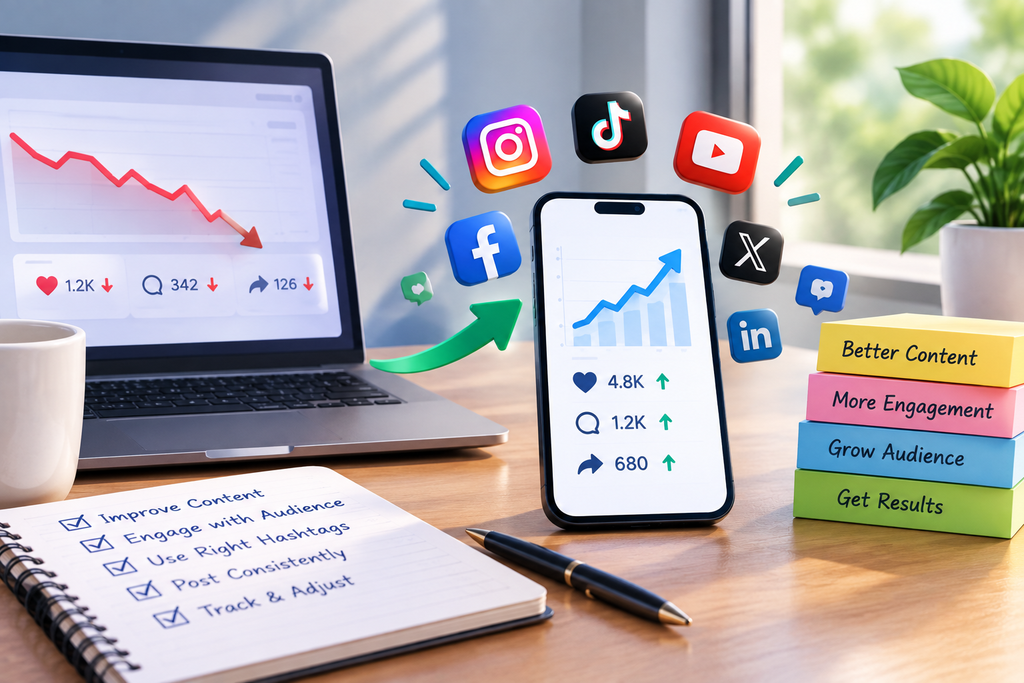
Once you identify the likely cause, avoid changing everything at once.
Use a controlled recovery process.
Step 1: Compare Your Recent and Previous Content
Review approximately 10–20 recent posts against a similar number of older posts.
Record:
- Reach
- Impressions or views
- Likes
- Comments
- Shares
- Saves
- Profile visits
- Link clicks
- Follows
- Leads or sales where measurable
Look for patterns instead of judging individual posts.
Step 2: Identify Your Strongest Topics
Find the subjects that consistently produced meaningful interactions.
Do not simply copy the exact post. Identify the underlying reason it worked.
Was it:
- A specific customer problem?
- A useful tutorial?
- A controversial industry question?
- A relatable experience?
- A product demonstration?
- A strong visual?
- A timely topic?
Then create new content around the same audience need.
Step 3: Stop Repeating Weak Content
If a particular topic has repeatedly produced poor results, pause it.
That does not mean the topic can never work. It means you need a different angle, format or audience connection before investing more content into it.
Step 4: Increase Useful and Shareable Content
Content should be useful enough that people want to save it or share it with someone else.
Practical examples include:
- Checklists
- Step-by-step tutorials
- Mistake-based posts
- Comparisons
- Templates
- Short explanations
- Frequently asked questions
- Original examples
Sprout Social’s research also identifies shareable content as an important part of increasing social interaction, particularly visual content such as short-form video and images. Sprout Social — Social Media Engagement
Step 5: Respond to Your Community
Do not treat comments as the end of the post.
Reply to useful comments, answer questions and continue conversations where appropriate. If customers repeatedly ask the same question, turn that question into future content.
This creates a feedback loop:
Audience question → content → engagement → new questions → better content
Step 6: Build a Strategy Around Business Goals
The final recovery step is to connect engagement with your actual objective.
If your goal is brand awareness, reach and video consumption may matter more.
If your goal is leads, track profile visits, website clicks, messages and inquiries.
If your goal is sales, measure conversions rather than celebrating engagement alone.
A stronger [INTERNAL LINK: social media strategy that generates customers] should therefore connect content topics, audience needs and measurable business actions rather than treating likes as the final objective.
When Should You Be Concerned About a Drop?
Do not panic because of one weak post or a few days of lower engagement.
A more meaningful warning sign is a persistent decline across multiple posts and metrics.
Pay particular attention when:
- Reach declines consistently
- Engagement rate falls at the same time
- Profile visits decrease
- Website clicks decrease
- Followers stop growing
- Content receives fewer shares and saves
- Qualified inquiries decline
At that point, compare your analytics with your previous normal performance and investigate the specific stage where the decline began.
Final Takeaway
A sudden social media engagement drop does not automatically mean that your account has been penalized or that you need to post more frequently.
The real cause may be audience changes, weaker content relevance, declining reach, repetitive formats, excessive promotion, inconsistent publishing or an audience that is no longer closely aligned with your business.
The most effective recovery process starts with diagnosis.
Compare recent performance with your historical baseline, separate reach problems from engagement problems, identify the topics that still resonate, test different formats and measure business actions alongside social interactions.
Most importantly, do not optimize your entire strategy around likes.
The goal is to build content that reaches the right people, gives them a reason to interact, develops trust and eventually supports the business outcome you actually care about.
FAQs
1. Why has my social media engagement suddenly dropped?
A sudden decline can result from lower reach, changes in audience interests, repetitive content, inconsistent posting, excessive promotional content or a mismatch between your current audience and the topics you publish. Check several recent posts rather than judging the account from one underperforming publication.
2. Does a drop in Instagram engagement mean my account is shadowbanned?
Not necessarily. Lower engagement can have many ordinary causes, including reduced reach, weaker content relevance or changes in audience behavior. Before assuming a restriction, compare reach, recommendations, content performance and account-status information available through the platform.
3. How long does it take to recover social media engagement?
There is no fixed recovery period. It depends on why engagement declined, how frequently you publish, your audience and the changes you make. Instead of expecting a specific number of days, monitor several consecutive posts and compare their performance with your previous baseline.
4. Should I post more when my social media engagement drops?
Not automatically. Increasing posting frequency without improving content relevance can create more low-performing content. First determine whether your problem is reach, content quality, audience mismatch or inconsistent publishing. Then choose a sustainable schedule that allows you to test improved content.
5. Why are my posts getting views but very few likes and comments?
Views indicate that people consumed or were exposed to your content, but they do not guarantee interaction. Your content may be reaching people outside your ideal audience, providing information without encouraging discussion, or using a format that is easy to consume without taking further action. Examine shares, saves, comments, profile visits and other metrics alongside views.
6. What is the fastest way to improve low social media engagement?
There is no universal quick fix. Start by identifying your strongest recent topics and the content characteristics they share. Then publish more useful, audience-specific content, test different formats, respond to conversations and measure performance over multiple posts. This is more reliable than randomly changing hashtags, posting times or frequency.
Let’s Talk About Your Business
Not sure which approach is right for your business? Get a free consultation with our team.



One Response